DEFI FUNDAMENTALS
Where to Get Even Higher Yields?
Every yield leaderboard shows you an APR. But that number is only part of the story. On top of the yield a protocol actually pays, crypto projects hand out a second, separate layer of value — points, airdrops, bonus tokens — that never shows up as APR. pigi.finance deliberately leaves that layer out of its numbers. Here is what it is, why we exclude it, and where to look if you want it.
Disclaimer. pigi.finance is not affiliated with liquidity.land or Stone Vault. This article is educational and not financial advice. Incentive programs are time-limited and change often — always check liquidity.land for current terms before depositing.
The yield you don't see
When you compare strategies on pigi.finance, the APR you see is realized, on-chain yield — interest actually paid, fees actually earned. It is measurable and it already happened.
But protocols compete for your deposit with more than yield. Around that APR sits a second layer — points, airdrops, bonus tokens — that can add meaningfully to your total return and never appears in an APR figure. This article maps that layer: what it is, why pigi.finance keeps it out of the numbers, and where to look if you want to chase it.
1. How crypto projects incentivize their users
A new protocol has a cold-start problem: it needs deposits and users, and a merely competitive APR is often not enough to attract them. So projects reach for incentives — value handed out on top of the base yield:
- Points programs. An off-chain tally you accrue by depositing or using a protocol. A point has no fixed value — it is a promise that, when the protocol launches its token, points holders receive an allocation. A points program is essentially a pre-token loyalty scheme.
- Airdrops. A retroactive token distribution to early or active users. Often unannounced; the value is unknown until the token actually trades.
- Token emissions / liquidity mining. The protocol pays out its own governance token on top of base yield. It shows up as a "reward APR", but it is inflationary and variable.
- Boosted campaigns & referral bonuses. Time-limited extra APY for new deposits, or rewards for bringing in other users.
These can dwarf the base yield — but they are speculative and unpriced. A point is not a token. An airdrop's value is unknown until the token-generation event. A boost ends. It is real upside, but you are being paid partly in lottery tickets.
2. Why pigi.finance doesn't count points
Every APR on the pigi.finance leaderboard is realized, on-chain yield. Points and prospective airdrops are deliberately excluded. Three reasons:
- Unpriced. A point has no market value until — and unless — a token launches.
- Speculative. The token may never come, the allocation formula can change, and an airdrop may exclude you entirely.
- Not realized. It has not happened yet. Counting it would mean counting a guess.
If pigi.finance folded an estimated point or airdrop value into APR, the leaderboard would stop being a record of what strategies have paid and become a set of marketing projections. We keep it conservative on purpose — consistent with how we treat inflationary versus real yield in Understanding DeFi Yield Sources.
The incentive layer is real — but by design it lives outside pigi.finance's numbers. Which raises the obvious question: where do you find it?
3. Where to find these incentives
Measuring realized yield and hunting incentive campaigns are two different jobs. pigi.finance is built for the first. If you specifically want the incentive layer — the boosts, the bonus campaigns — you need a venue built for the second.
One such platform is liquidity.land. It aggregates time-limited deals in one place: protocols offer boosted yields and bonuses to attract deposits, and liquidity.land surfaces those active offers so you can compare them. You connect a wallet, see what is currently boosted, and deposit through the platform to qualify.
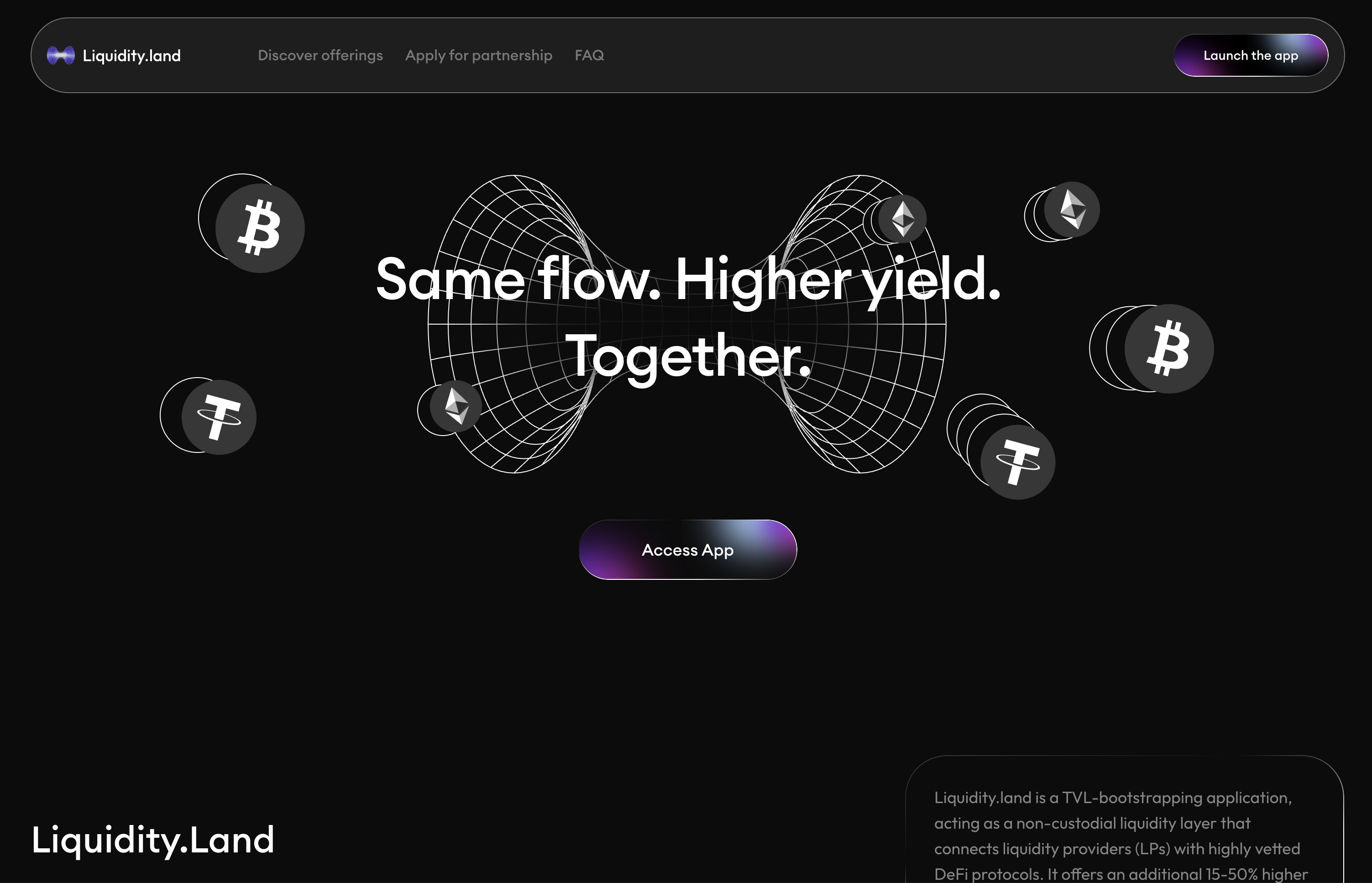
As noted above, pigi.finance is not affiliated with liquidity.land — we point to it because it is a clear example of the kind of venue where the incentive layer is surfaced.
4. Example: a Stone Vault boost on liquidity.land
To make it concrete, here is a representative deal of the type liquidity.land lists. (Campaigns rotate — treat the numbers below as an illustration, and check liquidity.land for whatever is live now.)
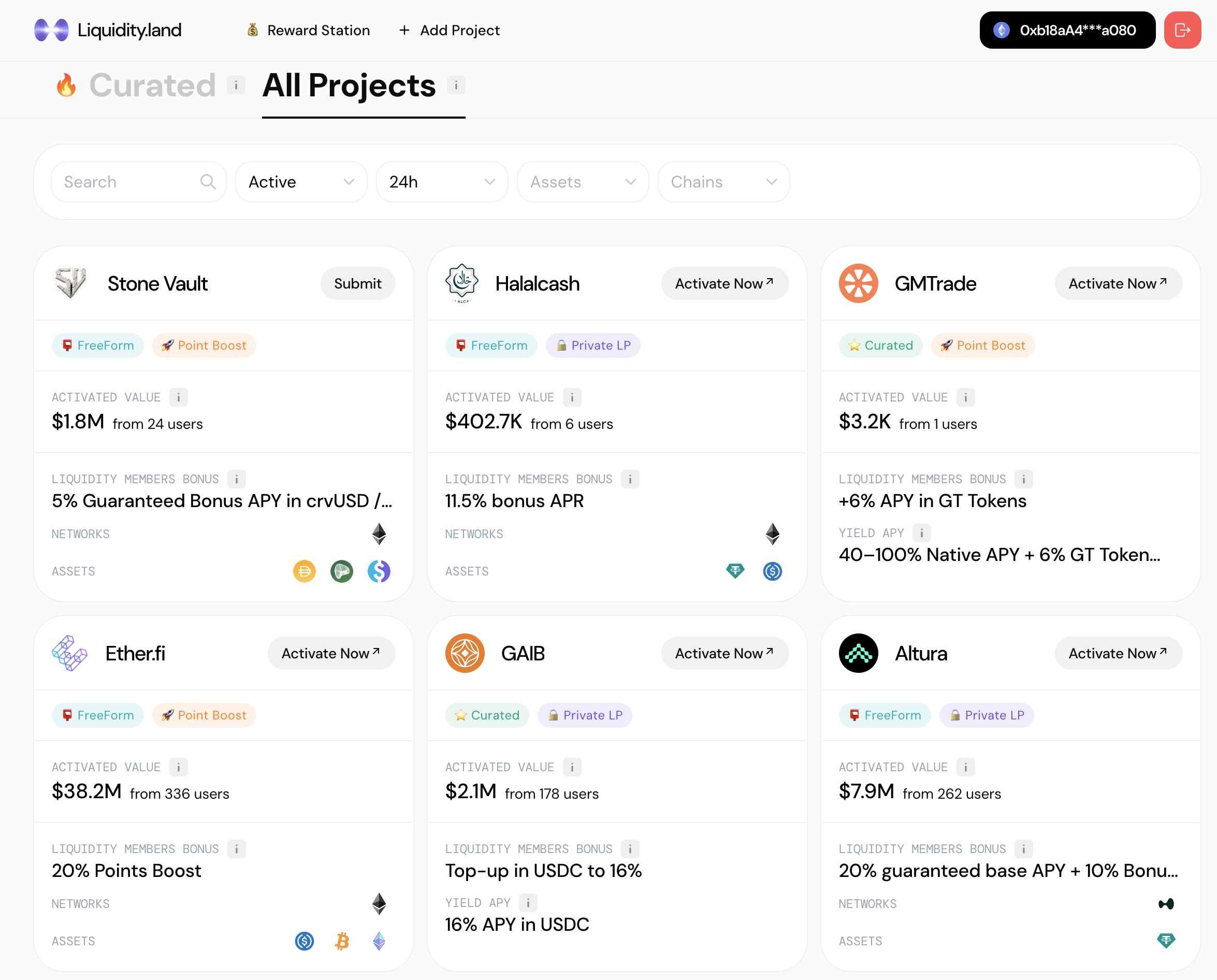
liquidity.land bills Stone Vault as offering "immutable yield on censorship-resistant stablecoins." In its own description, Stone Vault is a yield-aggregating stablecoin protocol built on Ethereum that automatically diversifies deposits across Spark, Aave and Curve to generate risk-adjusted returns across decentralized stablecoins. It issues SVT (Stone Vault Token), an ERC-20 share token representing ownership of the underlying diversified pool. The project is backed by Dome, a venture studio that designs and ships DeFi infrastructure and agent-powered products end to end.
A representative boost looked like this:
Representative liquidity.land boost - Stone Vault
  Assets        crvUSD, DAI, LUSD
  Base APY      ~5%   (Stone Vault's own yield)
  Bonus APY     ~5%   (liquidity.land campaign incentive)
  Total         ~10%
  Eligibility   new positions only
  Window        limited-time campaign
The bonus half is exactly the incentive layer this article is about. It is not part of Stone Vault's organic yield — it is a campaign sweetener, and campaigns end.
A boosted 10% on stablecoins is attractive — but read it the way pigi.finance would. The 5% bonus is an incentive, not sustainable yield. Stone Vault is a newer, smaller protocol than the Aave / Spark / Curve venues it sits on top of, which adds a layer of smart-contract risk. And the claim of "immutable" yield is the project's own framing — worth verifying, not assuming. The boost raises the reward; it does not lower the risk.
pigi.finance shows you the floor — the realized, risk-measured yield. The incentive layer can lift returns above that floor, but it trades certainty for upside. Always know which one you are being paid in.
Related reading
Understanding DeFi Yield Sources
Lending, liquidity mining, staking, RWAs and more — every category of DeFi yield, explained.
CAGR vs APR vs APY
Three numbers, three different questions — and how to compare DeFi yields without mixing them up.
What is a Vault in crypto?
ERC-4626, AMM pools, stability pools — pigi's unified definition of a Vault.