Vault Intelligence
for DeFi
pigi indexes 2,790 vaults across 25+ protocols and 14 EVM chains — daily history, a 0–100 risk score with A–F bands, and yield adjusted for the risk you're actually taking.
 Uniswap
 Morpho
 Euler
Euler Aave
Aave Lagoon
 Yearn
Yearn Curve
Curve IPOR
IPOR Frax
Frax Spark
Spark Fluid
Fluid
The allocator's stack
APR-chasing vs pigi
| Dimension | Picking by APR | pigi |
|---|---|---|
| Coverage | One protocol dashboard at a time | 2,000+ vaults · 25+ protocols · 14 EVM chains |
| Risk | Vibes, TVL and a Twitter scroll | 0–100 risk score + A–F band, recomputed nightly |
| Yield | The headline number | 30-day moving averages + risk-adjusted APR |
| History | Whatever the protocol shows today | Daily TVL / APR / APY series — Sharpe, Sortino, CAGR |
| Blow-ups | You find out on X | Hard floors publish same-day: exploits, depegs, blocked redemptions |
| Methodology | Black box | Versioned rulebook — every change ships with a changelog |
| Research | DYOR | In-depth vault reports |
| Programmatic access | Copy-paste from dashboards | REST API + MCP server for AI agents |
Picking vaults by headline APR compared with the pigi stack, across eight dimensions.
The risk engine
A 0–100 score, not a vibe.
Every rated vault carries a score (higher = safer) and a published band from A to F — recomputed nightly under a versioned rulebook, with every methodology change logged.
Quantitative anchor · 40%
Computed daily from observable inputs: deposit scale, 30-day yield volatility, yield sanity against the DeFi base rate, time in production, deposit flow.
Structural rosette · 60%
An analyst assessment against a published rulebook — security, governance, collateral quality, exit paths, counterparties. Most catastrophic DeFi losses were structural, so it carries the heavier weight.
Caps, overlays, hard floors
A vault is never safer than its weakest critical dependency — and hard floors cap the score the same day an exploit, depeg or blocked redemption fires.
Research
Vaults, taken apart.
The latest from our research desk — how DeFi vaults actually behave, worked out from the data behind pigi.
Market Outlook · Oct 26, 2026
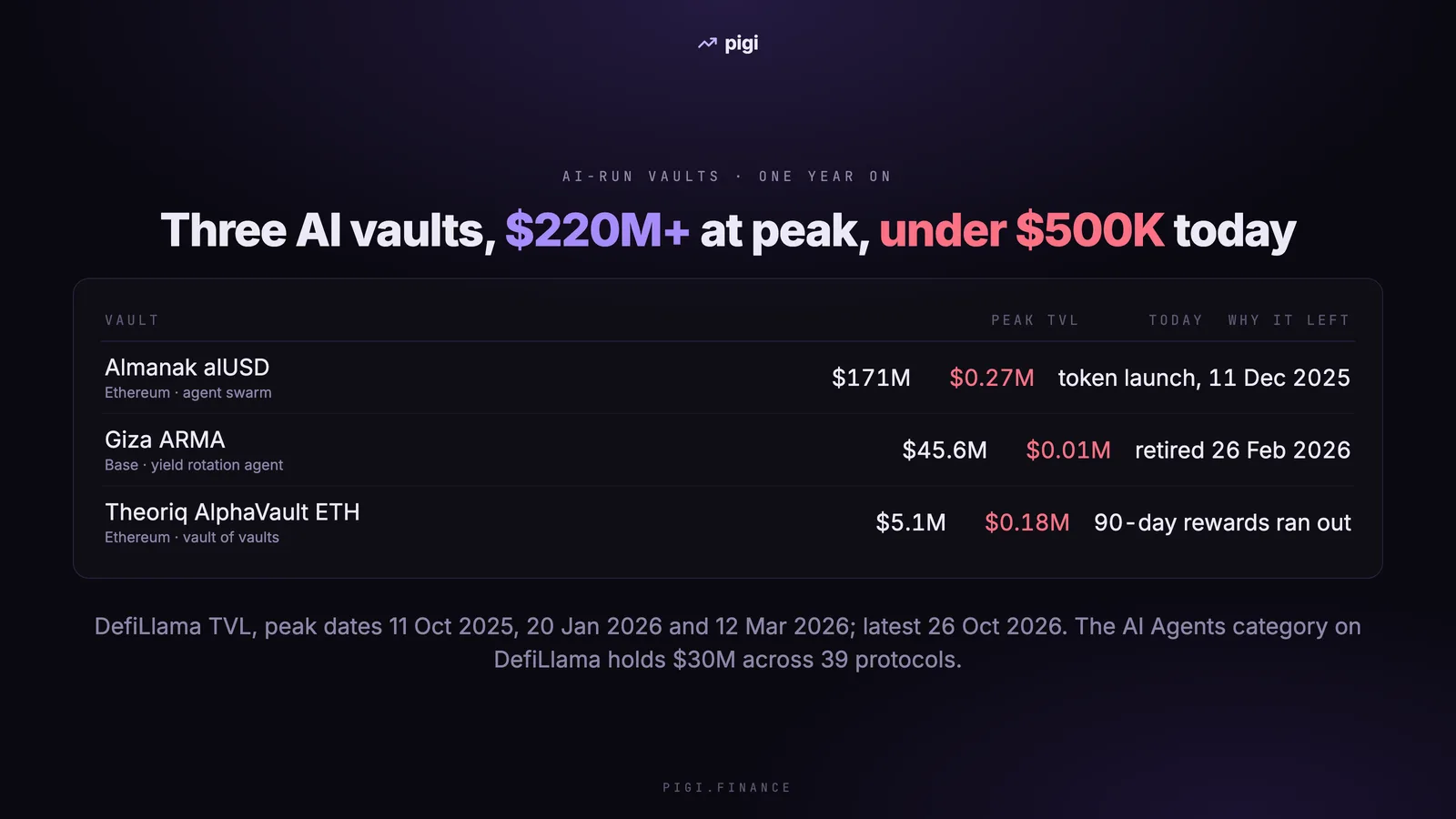
What Happened to the AI-Run Vaults? Almanak, Giza and Theoriq, One Year On
Three vaults promised that AI agents would manage DeFi yield. Together they peaked above $220M in TVL and hold under $500K today. The money left on three different schedules, and a dated TVL series shows why: a token launch, a strategy that could not scale, and a 90-day rewards campaign.
Read the article →
Vault Infrastructure · Oct 13, 2026
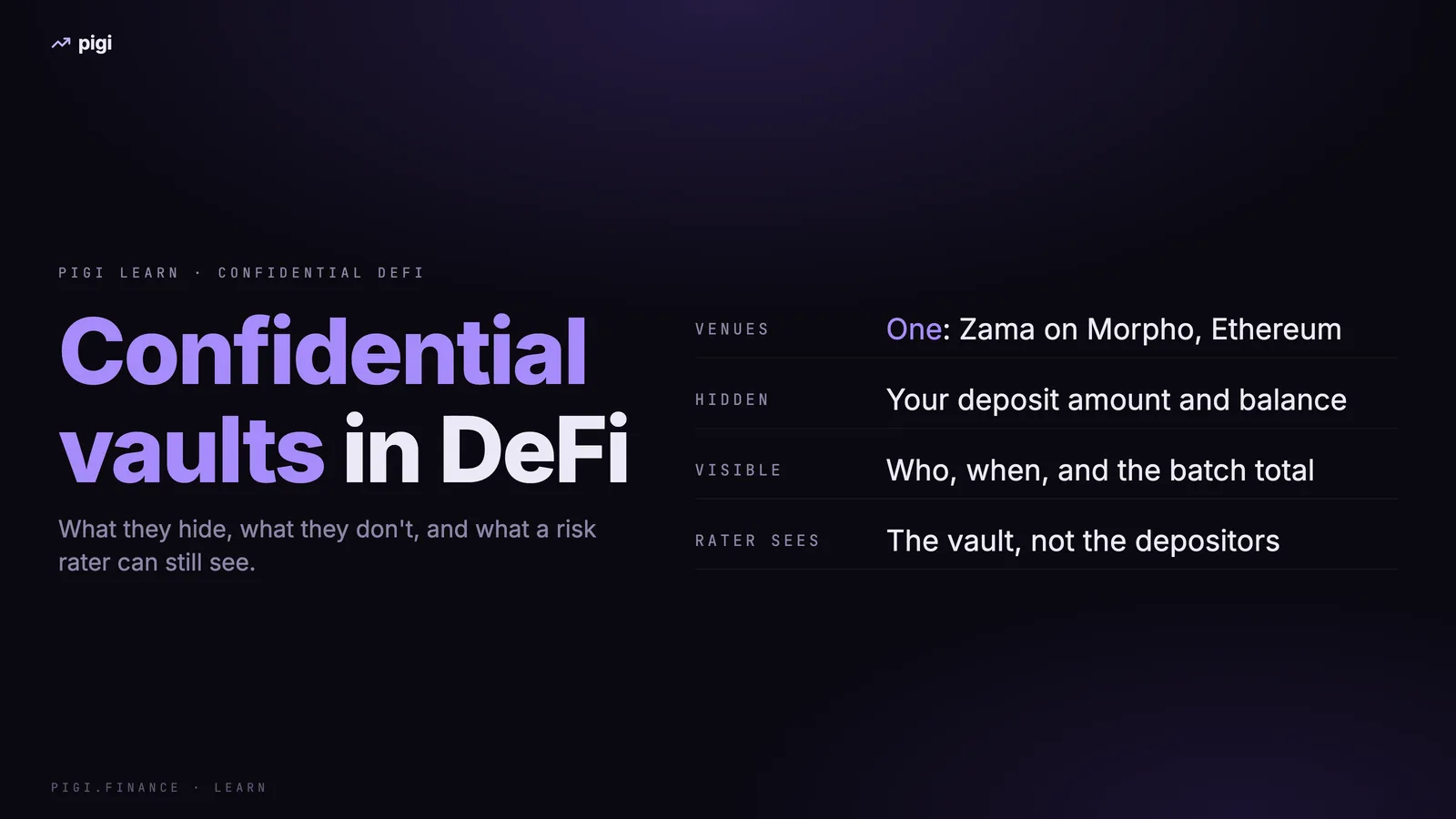
Confidential Vaults in DeFi: What They Hide, and What They Don't
Zama's 16 vaults on Morpho are the only live confidential yield vaults. How FHE keeps a deposit private, what stays public, how much money sits inside, how fast it is growing, and what a risk rater can still see.
Read the article →
DeFi Fundamentals · Sep 14, 2026
How Concentrated Are DeFi Vaults? Who Actually Owns the TVL?
TVL tells you how much capital is deposited. It doesn't tell you how that capital is distributed. Steakhouse's USDC vaults, same curator and asset, range from 3.24% to 99.65% in their largest holder's share — and concentration can shift materially in 30 days.
Read the article →
For builders
Put vault intelligence in your product.
The data behind these pages is one REST call away — daily history, windowed stats, risk bands, holders. There's an MCP server too, so your AI agent can use it directly.
FAQ
Questions, answered.
Is pigi affiliated with the protocols, curators or vaults it rates?
No. pigi is independent. No protocol, curator, allocator or vault pays us, and nobody can pay to be listed, rated or ranked higher.
Who is behind pigi?
A small, independent team that has been building in crypto and DeFi for over 10 years — engineers and analysts who got tired of picking vaults by headline APR. We build the indexer, the risk methodology and the research ourselves.
pigi on LinkedIn →Is this financial advice?
No. pigi publishes data and research to inform your own decisions. Nothing on the site is a recommendation to buy, sell or deposit into anything — DeFi carries real risk of loss, so do your own research.
Terms of service →How accurate is the risk rating?
The score is rules-based, not a black box: 40% is computed daily from on-chain data (deposit scale, yield volatility, time in production, deposit flows) and 60% is an analyst assessment against a published, versioned rulebook. Hard floors cut a score the same day an exploit, depeg or blocked redemption hits. It ranks relative risk between vaults — it is not a probability that a vault will lose money.
Read the methodology →Do you rely on a third-party indexer or API?
No. pigi runs its own in-house indexer that reads vault data straight from the chain. Owning the pipeline means we can add a new protocol, chain or metric without waiting on anyone else.
How fresh is the data?
Vault history — TVL, APR, APY and share price — is refreshed daily, and risk scores are recomputed nightly. Hard floors for exploits, depegs and blocked redemptions publish the same day.
Why is the APR different from what the protocol shows?
Protocols usually show a spot rate, which can spike for a few hours. pigi shows a 30-day moving average, plus a risk-adjusted APR that discounts the yield by the vault's risk score — so a high-yield, high-risk vault doesn't automatically rank first.
Why isn't my vault rated?
pigi indexes every vault it covers, but ratings need enough deposits and history to score meaningfully, so not every vault has one yet — and we keep adding more. Want a vault indexed or rated? DM us on X.
@pigi_finance on X →How much does it cost?
The leaderboard, vault pages, risk bands and research are free. The REST API and MCP server have a free tier with 1,000 requests a month; Pro is $200 a month.
API plans →Allocate with Confidence
The leaderboard is free — daily history, risk bands and risk-adjusted APR for every rated vault.
We use cookies
We use cookies to improve your experience and analyze site traffic. See our Cookies Policy for details.